CogniCare Pro Review: Does It Work?
A caffeinated B-vitamin capsule with small, undisclosed amounts of bacopa, rhodiola and huperzine A, sold as a memory supplement.
Reader-supported: if you buy through our links we may earn a commission, at no extra cost to you. It never changes our verdicts. Learn more
Quick answer
Is CogniCare Pro worth it?
Probably not for memory. CogniCare Pro is mostly B vitamins plus a 151 mg blend of caffeine sources, tyrosine, bacopa, rhodiola and huperzine A. Bacopa trials used about 300 mg a day on its own, so the dose here is far lower. It may feel stimulating, but there's little reason to expect memory gains. Huperzine A is drug-like and shouldn't be combined with dementia medications.
Our verdict
Editorial score out of 10. How we score
May suit
- Adults who mainly want a caffeine-plus-B-vitamin pick-me-up and accept the price
Skip it if
- You take donepezil, rivastigmine, galantamine or anticholinergic drugs (huperzine A)
- You're caffeine-sensitive, pregnant, nursing or under 18
- You have new or worsening memory problems that haven't been checked by a doctor
Prices checked November 16, 2026. They change often.
What we like
- B-vitamin doses are clearly disclosed
- Bacopa extract is standardized (20% bacosides)
- 90-day refund window
What we don't
- Seven active ingredients share a 151 mg blend, so bacopa is far below the 300 mg studied
- Caffeine amount isn't stated despite three stimulant sources
- Huperzine A content is hidden, though it acts like a dementia drug
- Sales page markets rice flour and magnesium stearate (capsule fillers) as brain ingredients
- Promotes phosphatidylserine, which isn't on the label
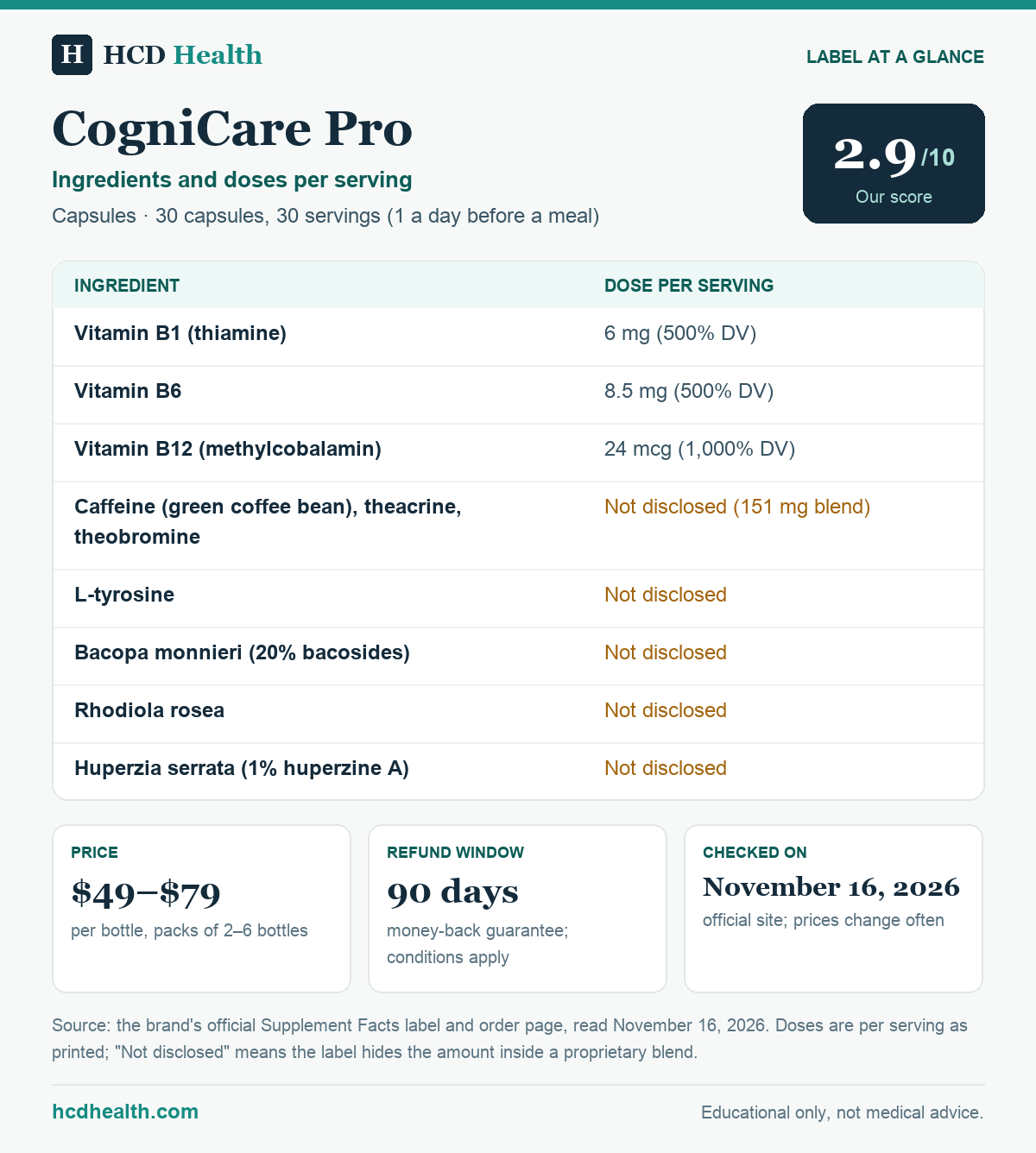
CogniCare Pro ingredients and doses
From the Supplement Facts image on cognicarepro.com. Other ingredients: rice flour, vegetable capsule, magnesium stearate, silicon dioxide.
| Ingredient | Dose per serving | Why it's there |
|---|---|---|
| Vitamin B1 (thiamine) | 6 mg (500% DV) | B vitamin |
| Vitamin B6 | 8.5 mg (500% DV) | B vitamin |
| Vitamin B12 (methylcobalamin) | 24 mcg (1,000% DV) | B vitamin; helps only if you're deficient |
| Caffeine (green coffee bean), theacrine, theobromine | Not disclosed (151 mg blend) | Stimulants |
| L-tyrosine | Not disclosed | Amino acid; studied at gram doses under stress |
| Bacopa monnieri (20% bacosides) | Not disclosed | Best-studied memory herb; ~300 mg/day in trials |
| Rhodiola rosea | Not disclosed | Adaptogen; mixed evidence for fatigue |
| Huperzia serrata (1% huperzine A) | Not disclosed | Cholinesterase inhibitor (drug-like) |
Format: Capsules. 30 capsules, 30 servings (1 a day before a meal). Taken from the brand's published label on November 16, 2026.
CogniCare Pro claims vs. the evidence
We took the main promises from the official sales page and checked them against published human research.
“Supports focus, memory, learning, accuracy, concentration and reasoning”
Weak evidenceBacopa improved memory and attention in trials at about 300 mg/day for 12 weeks. Here it shares a 151 mg blend with six other ingredients. Caffeine may sharpen alertness short-term, which isn't the same as better memory.
“Plant-sourced phosphatidylserine improves brain performance”
Not supportedPhosphatidylserine isn't listed on CogniCare Pro's label, so this claim doesn't apply to the product.
“Rice flour improves blood flow to the brain; magnesium stearate supports cognitive function”
Not supportedBoth are standard capsule fillers with no cognitive role.
What is CogniCare Pro?
CogniCare Pro is a once-daily capsule marketed to support "six indicators of brain performance". It's sold through a video sales page and BuyGoods checkout. Its label lists the same Aurora, Colorado distributor address as Sugarmute.
What's in it, and does it work?
The label has three clearly dosed B vitamins and a 151 mg proprietary blend of seven ingredients: caffeine from green coffee, L-tyrosine, theacrine, theobromine, bacopa, rhodiola and huperzine A.
- Bacopa is the ingredient with the best memory evidence. A 12-week trial in adults 65+ used 300 mg a day of standardized extract and found better word recall (source). CogniCare Pro's whole blend is half that, shared between seven ingredients.
- Huperzine A improved cognitive scores in trials of people with dementia (source). But it works like a prescription dementia drug, and the amount in CogniCare Pro isn't disclosed.
- Caffeine, theacrine and theobromine can make you feel more alert. That's a short-term stimulant effect, not improved memory.
- B vitamins help memory only if you're deficient. A blood test can tell you.
See our guide: Memory supplements: which ingredients have real evidence?
Better alternatives
- If you want to try bacopa, choose a single-ingredient product with about 300 mg of standardized extract and give it 12 weeks.
- Ask your doctor to check B12 and thyroid levels if you've noticed memory changes.
- Exercise, sleep, hearing care and managing blood pressure have good evidence for long-term brain health.
Our bottom line
CogniCare Pro is a stimulant-and-B-vitamin capsule with token amounts of research-backed herbs and a hidden dose of a drug-like compound. We wouldn't buy it for memory.
CogniCare Pro price and refund policy
2 bottles
$158
$79/bottle + shipping
3 bottles
$207
$69/bottle, free US shipping
6 bottles
$294
$49/bottle, free US shipping
- 90-day money-back guarantee. The written policy requires an RMA, return shipping at your cost, and product 'in good physical condition'; it doesn't say whether opened bottles qualify.
- The homepage also showed a single bottle for $179, which is more than the 2-bottle package. Confirm the price at checkout.
- Buy only from the official site. Copies sold on marketplaces may be counterfeit, and the money-back guarantee usually applies only to official orders.
Is CogniCare Pro safe? Side effects and interactions
- Huperzine A is a cholinesterase inhibitor. Don't combine it with prescription dementia drugs or anticholinergic medications without your doctor.
- Contains caffeine, theacrine and theobromine in undisclosed amounts; may cause jitteriness or poor sleep.
- Bacopa commonly causes mild stomach upset.
- Memory changes can have treatable causes (thyroid, B12 deficiency, depression, sleep apnea, medications). See a doctor first.
Red flags we noticed
- The sales page lists rice flour and magnesium stearate (fillers) as if they were active brain ingredients.
- It promotes phosphatidylserine, which isn't on the label.
- The single-bottle price shown ($179) is higher than the two-bottle package.
- Uses the same sales-page template, a near-identical price grid, '4.98/5' rating and 'not a single complaint' line as several other video-ad supplements we reviewed. The rating and testimonials can't be verified.
CogniCare Pro FAQ
Does CogniCare Pro work?
There are no trials of CogniCare Pro itself. Its best ingredient, bacopa, worked in trials at about 300 mg a day, while CogniCare Pro's entire blend is 151 mg shared with six other ingredients. You may feel the caffeine, but memory benefits are unlikely.
What are the ingredients in CogniCare Pro?
Vitamins B1, B6 and B12, plus a 151 mg blend of green coffee caffeine, L-tyrosine, theacrine, theobromine, Bacopa monnieri, Rhodiola rosea and Huperzia serrata (huperzine A).
Is CogniCare Pro safe?
For most healthy adults the risks are mainly from caffeine. But it contains huperzine A, which acts like a dementia drug, so don't combine it with donepezil, rivastigmine, galantamine or anticholinergic medications without your doctor.
How much is CogniCare Pro?
On November 16, 2026: 2 bottles for $158 plus shipping, 3 for $207 and 6 for $294 with free U.S. shipping. A single bottle was shown at $179.
Sources
We link to primary research and government fact sheets. Each link was opened and checked when this page was last updated.
- Bacopa monnieri: Healthy adults 65+ taking 300 mg/day for 12 weeks improved delayed word recall versus placebo. RCT, n=54
- Bacopa monnieri: Improved speed of attention across 9 trials. Meta-analysis of 9 RCTs, n=518
- Huperzine A: Improved cognitive scores in people with Alzheimer's or vascular dementia; authors urge caution. Meta-analysis of RCTs
- L-tyrosine: May help cognition mainly under acute stress or high demand. Review
- Rhodiola rosea: Possible benefits for mental performance but little independent replication. Systematic review of 11 RCTs