Audifort Review: Does It Work?
A 'hearing support' drop whose label is a generic weight-loss and energy blend: African mango, raspberry ketones, guarana, green tea and amino acids. Nothing in it is shown to help tinnitus.
Reader-supported: if you buy through our links we may earn a commission, at no extra cost to you. It never changes our verdicts. Learn more
Quick answer
Is Audifort worth it?
No. Audifort's label lists no ingredient with credible evidence for tinnitus or hearing. It's essentially the same 200 mg weight-loss and energy blend sold as Sugar Defender. The 2026 U.S. tinnitus guideline advises against supplements for tinnitus; a hearing test, hearing aids if needed, and CBT have better evidence.
Our verdict
Editorial score out of 10. How we score
May suit
- We can't identify anyone likely to benefit, based on the label and the research
Skip it if
- You have new, one-sided or pulsing tinnitus, or sudden hearing loss (see a clinician promptly)
- You're caffeine-sensitive or take stimulants, MAOIs or serotonergic antidepressants
- You're pregnant, nursing or under 18
Prices checked November 16, 2026. They change often.
What we like
- Full ingredient list is published on the label
- 90-day refund window
What we don't
- No ingredient has replicated human evidence for tinnitus or hearing
- Formula matches a weight-loss/energy blend (and Sugar Defender's label)
- All herbal doses hidden in a 200 mg proprietary blend
- The brand's reference list includes a spiritual book
- Smallest order is 2 bottles
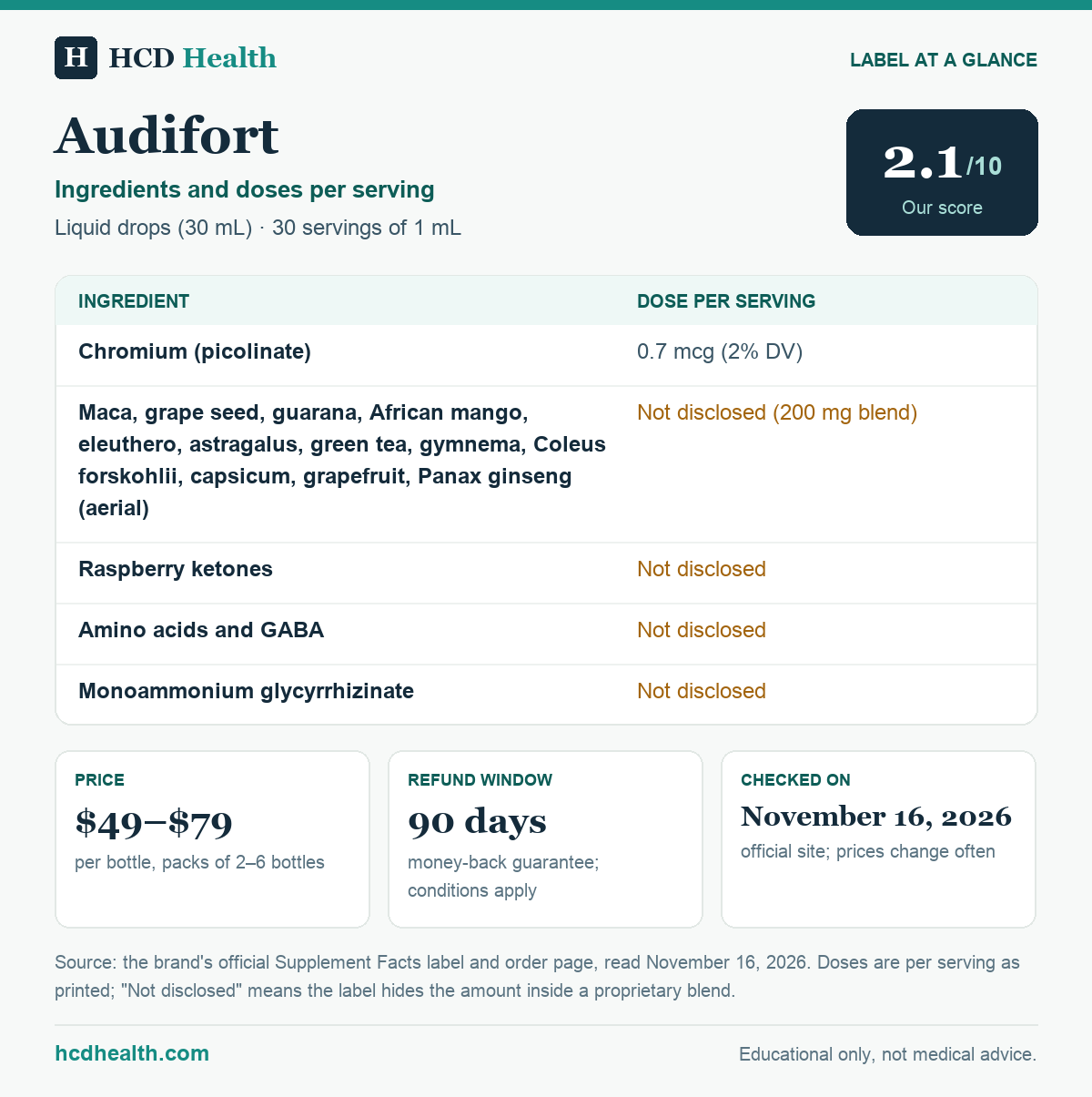
Audifort ingredients and doses
From the Supplement Facts image on audifort.com. Serving size 1 mL; the label suggests one or two droppers a day.
| Ingredient | Dose per serving | Why it's there |
|---|---|---|
| Chromium (picolinate) | 0.7 mcg (2% DV) | No hearing role |
| Maca, grape seed, guarana, African mango, eleuthero, astragalus, green tea, gymnema, Coleus forskohlii, capsicum, grapefruit, Panax ginseng (aerial) | Not disclosed (200 mg blend) | Weight-loss, energy and 'adaptogen' herbs |
| Raspberry ketones | Not disclosed | Weight-loss ingredient; insufficient research |
| Amino acids and GABA | Not disclosed | Energy-blend ingredients |
| Monoammonium glycyrrhizinate | Not disclosed | Licorice-derived sweetener |
Format: Liquid drops (30 mL). 30 servings of 1 mL. Taken from the brand's published label on November 16, 2026.
Audifort claims vs. the evidence
We took the main promises from the official sales page and checked them against published human research.
“You will notice less noise and better ear health”
Not supportedNo trial of Audifort exists, and no ingredient on its label has replicated evidence for tinnitus. The 2026 AAO-HNS guideline says clinicians should not recommend dietary supplements for bothersome tinnitus.
“Over 20 research-backed ingredients that support healthy hearing”
Not supportedThe ingredients are mostly weight-loss and energy compounds. The one ginseng tinnitus trial we found was small and open-label, and only its 3,000 mg-a-day red ginseng root group improved on one tinnitus questionnaire, versus Audifort's 200 mg total blend.
What is Audifort?
Audifort is a liquid supplement marketed as "360-degree hearing support" for people with ringing ears. It's sold through a video sales page and the BuyGoods checkout. The label lists the distributor at a private mailbox address in Miami, Florida.
What's actually in the bottle
Audifort's Supplement Facts panel lists chromium (0.7 mcg) and a 200 mg proprietary blend that includes African mango, raspberry ketones, Coleus forskohlii, guarana, green tea, gymnema, maca, ginseng and seven amino acids. That's a classic weight-loss and energy-drop formula. In fact, it matches the label of Sugar Defender, which is sold for blood sugar.
None of these ingredients has credible human evidence for tinnitus or hearing loss.
What the research says about tinnitus supplements
- The 2026 U.S. clinical practice guideline from the American Academy of Otolaryngology–Head and Neck Surgery Foundation says clinicians should not recommend dietary supplements for persistent, bothersome tinnitus (guideline).
- Cochrane reviews found no benefit from ginkgo or zinc, the most-studied tinnitus supplements. Audifort doesn't contain either.
- In a survey of 1,788 people with tinnitus, most supplement users reported no effect and about 1 in 10 said their tinnitus got worse (source).
Read more in our guide: Do tinnitus supplements work?
What to do instead
- Get a hearing test from an audiologist. Hearing aids help many people whose tinnitus comes with hearing loss.
- Ask about cognitive behavioral therapy (CBT) for tinnitus, which has the best evidence for reducing distress.
- Try sound enrichment at night (fans, white-noise apps).
- See a doctor promptly if tinnitus is sudden, in one ear, pulsing, or comes with hearing loss or dizziness.
Our bottom line
We can't find a reason to expect Audifort to reduce tinnitus. Its formula is a low-dose weight-loss blend, and its references don't support its claims. Save your money for a hearing evaluation.
Audifort price and refund policy
2 bottles
$158
$79/bottle + shipping
3 bottles
$207
$69/bottle, free US shipping
6 bottles
$294
$49/bottle, free US shipping
- 90-day money-back guarantee. The order page says even empty bottles can be returned, but the written policy requires you to email for a return authorization (RMA), pay return shipping yourself, and the refund excludes original shipping and handling.
- Buy only from the official site. Copies sold on marketplaces may be counterfeit, and the money-back guarantee usually applies only to official orders.
Is Audifort safe? Side effects and interactions
- Contains caffeine (guarana, green tea) in undisclosed amounts.
- Contains L-tryptophan; ask a pharmacist if you take antidepressants.
- Licorice-derived and grapefruit ingredients can interact with some medications.
- Most importantly: a supplement shouldn't delay a hearing evaluation, especially for sudden or one-sided symptoms.
Red flags we noticed
- The brand's 'Scientific References' list includes 'A Course in Miracles', a spiritual book, alongside a rat study and general tinnitus papers.
- Its label matches Sugar Defender's, a product sold for blood sugar.
- The distributor address is a private mailbox (PMB), and many lookalike 'official' domains exist. Buy only from audifort.com if at all.
- Uses the same sales-page template, a near-identical price grid, '4.98/5' rating and 'not a single complaint' line as several other video-ad supplements we reviewed. The rating and testimonials can't be verified.
Audifort FAQ
Does Audifort work for tinnitus?
There's no published trial of Audifort, and none of its ingredients has replicated evidence for tinnitus. The 2026 U.S. tinnitus guideline advises clinicians not to recommend supplements for bothersome tinnitus.
What are the ingredients in Audifort?
Chromium picolinate (0.7 mcg) and a 200 mg blend of maca, grape seed, guarana, African mango, eleuthero, astragalus, green tea, gymnema, Coleus forskohlii, capsicum, grapefruit, Panax ginseng, raspberry ketones, amino acids, a licorice derivative and GABA.
Is Audifort a scam?
It's a real product with a refund policy, but its marketing makes hearing claims its ingredients don't support, its label matches a blood sugar product, and its reference list includes a spiritual book. We don't recommend it.
Are Audifort drops or capsules?
Liquid drops: a 30 mL bottle with a 1 mL serving. Some third-party pages wrongly describe capsules.
What actually helps tinnitus?
A hearing evaluation, hearing aids when there's hearing loss, cognitive behavioral therapy and sound enrichment have the best evidence. Sudden or one-sided tinnitus needs prompt medical attention.
Sources
We link to primary research and government fact sheets. Each link was opened and checked when this page was last updated.
- Supplements for tinnitus (overall): Clinicians should not recommend dietary supplements for persistent, bothersome tinnitus. AAO-HNS clinical practice guideline, 2026
- Supplements for tinnitus (real-world use): Among 1,788 people with tinnitus, 70.7% of supplement users reported no effect and 10.3% felt worse. Online survey
- Korean red ginseng: Only the 3,000 mg/day group improved on one tinnitus questionnaire; no group improved on symptom scores. Open-label pilot RCT, n=61
- Coleus, raspberry ketone, African mango: Weak or no evidence even for weight loss. NIH ODS fact sheet